

What is Research and Development (R&D)? Definition, Rules & Framework
Technical Synonyms & Legal Classifications
Within global and Indian corporate jurisprudence, Research and Development is recorded under diverse authentic nomenclatures across regulatory and legal documents. It is primarily searched and classified via the following frameworks:
- Product Innovation Framework
- Industrial Research and Technological Development - IRTD
- Experimental Development Structure
- Intangible Capital Asset Creation
- Scientific Research and Knowledge Advancement - SR&KA
Financial Terminology Origin & Global-Indian Matrix
Key Takeaways
To absorb the operational philosophy and structural backbone of this framework, observe its primary takeaways:
- Future Protection Shield: R&D functions as a legal and commercial defensive mechanism, insulating an enterprise from sudden bankruptcies or market expulsions triggered by severe technological transitions.
- Intangible Capital Asset Formation: Capital deployed into this ecosystem builds a highly valuable defensive asset class in the form of Intellectual Property (IP), including patents, copyrights, and trademarks.
- Market Monopoly Creation: Successful research pipelines empower corporations to unveil entirely unprecedented items, eliminating immediate competition and establishing absolute market dominance.
- Structural Cost Optimization: R&D is not confined to creating entirely new portfolios; refining existing fabrication workflows to drop unit cost metrics forms a primary financial goal.
- Regulatory and Audit Compliance: To successfully qualify research financial claims under statutory tax deduction rules, an enterprise must strictly satisfy governmental and accounting standards.
Two Simple Practical Indian Examples to Understand R&D
Before scrutinizing complex balance sheet equations and equity allocations, let us observe two practical domestic case studies that illustrate this phenomenon in everyday commercial environments:
(1) Parle-G — The FMCG Sector Innovation
- The R&D Implementation Method: Parle deployed systematic laboratory research and extensive consumer analytics, tracking a clear paradigm shift toward premium consumption and wellness metrics.
- The Operational Yield: Backed by these research insights, they formulated and launched Parle-G Gold (a higher premium variant) and Parle-G Oats & Berries (targeting wellness-oriented consumers).
- The Business Lesson: The underlying foundational product was preserved, yet continuous experimental iteration captured entirely new consumer cohorts without diluting legacy revenue.
(2) Mahindra Scorpio — The Automotive Evolution Study
- The R&D Implementation Method: Mahindra channeled heavy funding into their core institutional facility, the Mahindra Research Valley, ensuring advanced engineering development.
- The Operational Yield: This systematic capital deployment powered the launch of the Scorpio-N and Scorpio Classic, both securing dominant market traction. If Mahindra had frozen innovation, market dynamics would have rendered their legacy platforms entirely obsolete.
- The Business Lesson: True R&D is the perpetual execution of structural self-upgradation to manufacture premium assets aligned with modern structural shifts.
Market Mechanics & Structure
Phase 1: Statutory Formation and Policy Formulation
Phase 2: Regulatory Registration and Infrastructure Setup
Phase 3: Intellectual Property Exploitation and Commercial Integration
Ownership & Shareholding Structure
- Founders and Core Promoters: During the initial capitalization phase, founders bear the primary operational risk. They tightly retain majority voting equity to shield the enterprise's long-term vision from short-term minority shareholder disruptions.
- Venture Capitalists and Institutional Investors: Because R&D demands massive liquidity injections, external institutional capital is introduced. These entities typically demand Preferred Shares or unique equity covenants designed to protect their baseline capital in the event of pipeline termination.
- Scientists and Core Researchers: The underlying equity value of an R&D corporation is directly linked to its human capital. To insulate the firm from talent attrition, Employee Stock Ownership Plans (ESOPs) are deployed, transforming core researchers into partial equity owners rather than simple salaried personnel.
- Strict Equity Transfer Rules: Shareholders are bound by a rigid Shareholders' Agreement (SHA) containing pre-emption clauses. No majority or minority partner can alienate or transfer their equity chunk to a competing market player without receiving absolute validation from the Board of Directors and verifying regulatory compliance, protecting technical secrets from corporate espionage.
Corporate Structural Matrix (Comparative Chart of Different Business Models)
To observe how diverse business models allocate capital and absorb the structural risks associated with intensive R&D pipelines, review the comparative matrix below:| Specific Corporate Parameter | R&D Driven Model (R&D Focused Entity) | Limited Liability Partnership (LLP Model) | Traditional Public Limited Company (Traditional Public Ltd) |
|---|---|---|---|
| Core Business Objective | Creating new intellectual property and innovation | Providing professional services or trading at a limited level | Large-scale manufacturing and distribution of established products |
| Nature of Capital Allocation | Investment in uncertain and high-risk intangible assets | Suited for stable and daily operational expenses | Balanced allocation between shareholder dividends and physical assets |
| Tax Exemptions & Legal Benefits | Heavy tax deductions based on standards set by the regulator | Subject to standard corporate tax structures | Only standard industrial concessions and depreciation benefits |
| Risk & Personal Liability | Limited liability for shareholders, but the failure rate is very high | Liability limited to partners' contributions, low operational risk | Investors' risk is fully diversified and subject to the market |
Market Yields & Advantages
Corporations that prioritize extensive capital deployment toward R&D secure deep structural and legal advantages within the commercial arena:- Substantial Tax Incentives: Sovereign states universally extend massive tax deductions to stimulate domestic innovation. Under corporate rules of the prevailing financial cycle, qualified entities can fully deduct R&D outlays from their taxable corporate earnings, heavily lowering net tax exposure.
- Impenetrable Asset Protection Shield: The patents and trademarks secured via systematic R&D function as a binding legal firewall. Competitors are statutorily barred from duplicating the proprietary architecture, ensuring safe long-term market capture.
- Premium Brand Credibility: An enterprise that consistently rolls out pioneering technological breakthroughs is recognized globally as a market leader. This commands intense institutional trust among vendors, clients, and capital providers, facilitating easy future debt or equity issuance.
- Maximization of Operational Efficiency: R&D is not restricted to product creation; it actively modernizes underlying industrial fabrication cycles. This curbs material wastage, optimizes logistics, and yields highly refined assets at lower production thresholds, expanding net margins.
Strict Regulatory Rules and Statutory Shield for Tax Exemptions
- Dual Deduction on Revenue & Capital Expenditure: Under parameters validated by the regulator, routine operational outflows incurred to sustain the research division—including researcher payroll, laboratory inputs, and consumables—qualify for a 100% immediate write-off against the revenue of the current financial year. Concurrently, capital outlays utilized to acquire technical instrumentation or heavy testing machinery (strictly excluding real estate acquisitions) qualify for full tax deduction claims up to the applicable statutory limit.
- Amortization of Pre-commencement R&D Expenses: Enterprises frequently execute heavy research operations multiple years prior to generating commercial revenues. Legally, research capital deployed within a fixed block of years (such as the prevailing three-year window) directly preceding the date of official commercial launch can be fully accumulated. Upon launching commercial production, this entire accumulated pre-commencement sum can be asserted as a valid tax deduction during the initial financial assessment, effectively neutralizing tax liability.
- Official Recognition of In-house R&D Centers (DSIR Recognition Norms): To assert any fiscal write-off claim, it is a strict legal prerequisite that the corporation’s internal research facility holds valid accreditation issued by the Department of Scientific and Industrial Research (DSIR). In the absence of this official registration, statutory tax auditors dismiss the reported research outlays, treating them as regular corporate expenditures and revoking all tax incentive claims.
- Cross-Border R&D Adjustments: When an entity outsources structural components of its research pipeline to foreign testing labs or international expertise pools, rigid transfer pricing documentation and arm's length regulations apply. Under prevailing fiscal policies, only a fixed, pre-determined ratio up to the applicable statutory limit can be written off, while the excess expenditure is taxed at baseline corporate brackets.
Risk Exposure & Limitations
- High Sunk Cost Vulnerability: The absolute corporate reality of R&D is the total absence of guaranteed success metrics. After dedicating capital across extensive multi-year testing cycles, if the underlying scientific thesis collapses, the deployed capital converts completely into an unrecoverable Sunk Cost, impacting retained earnings.
- Extended Gestation Period: The temporal delta spanning the initial laboratory hypothesis to final market monetization routinely spans multiple years. Throughout this elongated timeline, the enterprise must continuously allocate liquid cash without any incoming revenue offsets, heavily straining cash flow dynamics.
- Risk of Rapid Technological Obsolescence: If an enterprise spends consecutive years engineering a specific technological architecture, and a competitor suddenly debuts a fundamentally superior and cheaper configuration, the entire internal research pipeline becomes completely obsolete overnight.
- Severe Personal and Corporate Liabilities: If testing safety thresholds are ignored or a third-party intellectual property domain is breached even inadvertently, the enterprise faces massive civil litigation and punitive regulatory fines, drawing immediate personal liability threats to the directors.
Setup & Compliance Cost Structures
- Initial Registration & Regulatory Filing Fees: Formal applications requesting official DSIR validation incur statutory costs, alongside outlays for engineering verifications, equipment calibrations, and legal drafting fees. These parameters scale entirely in accordance with applicable corporate guidelines.
- Intellectual Property Protection Costs: Guarding research breakthroughs requires deploying capital for domestic and global patent filings, international attorney fees, and annual patent preservation dues, varying in a fluid ratio across target market geographies.
- Recurring Statutory Audit & Compliance Expenses: To neutralize the risk of tax incentive manipulation, state auditing panels initiate intense technical inspections. The enterprise is under a strict statutory mandate to operate research accounts completely separate from routine corporate ledgers inside a dedicated cost-center, creating recurring compliance overheads.
Corporate Balance Sheet & Asset-Equity Dynamics
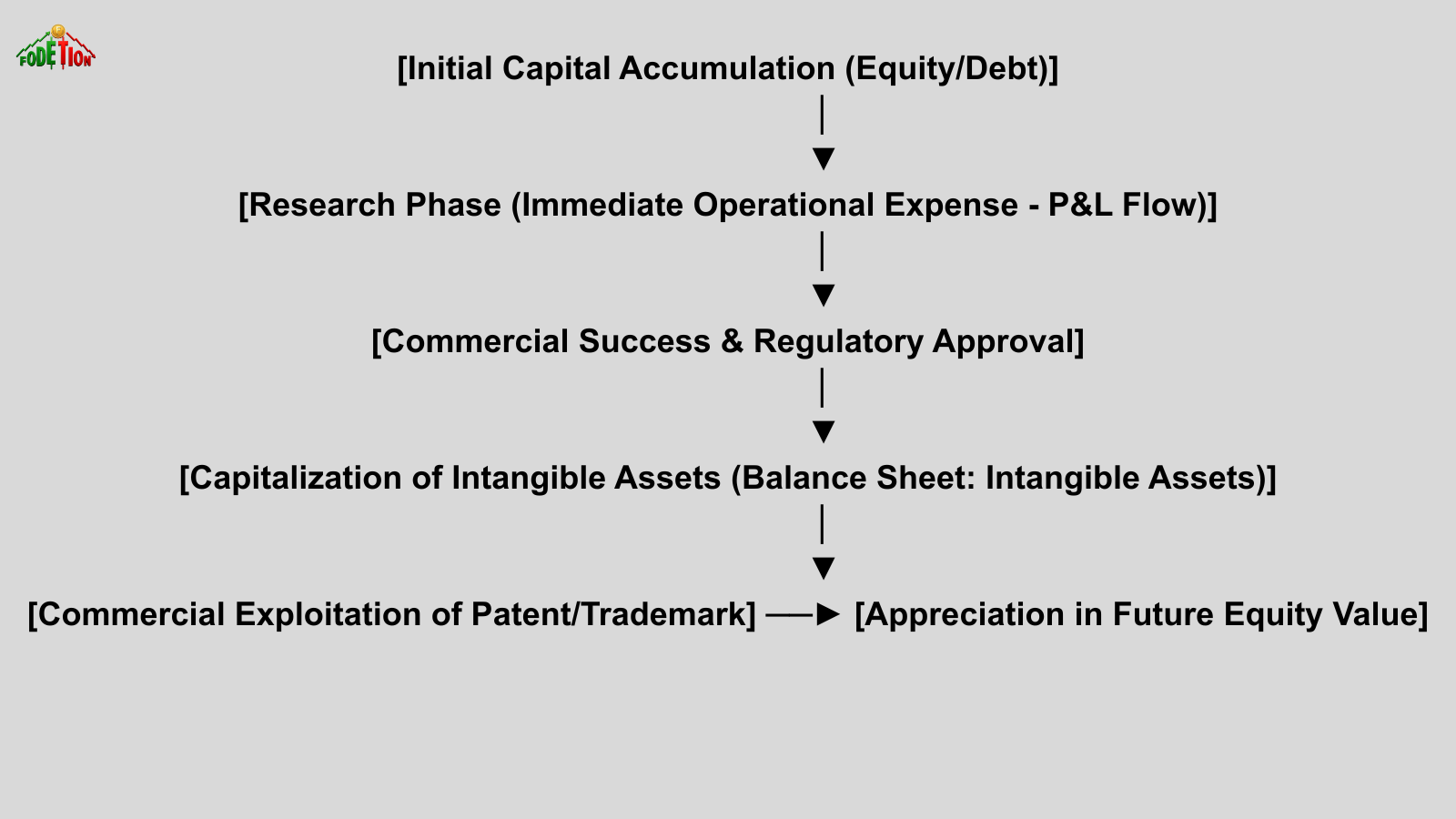
1. Initial Capital Accumulation
2. Equity Allocation & Expense Flow
3. Capitalization of Intangible Assets
Technical Veil & Market Signals
In modern corporate governance, utilizing R&D frameworks as a shield to hide illegitimate financial actions is a severe breach, commonly penalized via 'Piercing the Technical Veil'.
Industrial Cross-Sector Matrix
- Pharmaceutical & Biotech Vertical: This sector faces the tightest regulatory boundaries. Prior to securing commercial validation, a newly formulated molecule must pass through extensive, multi-year Clinical Trials. Given the massive gestation periods and high pipeline attrition rates, capital outlays can only be capitalized as an Intangible Asset after receiving definitive regulatory clearance for the final testing phases.
- Information Technology & Software Vertical: The R&D framework here focuses on mathematical software algorithms, artificial intelligence models, and core system architectures. Technical Feasibility is established rapidly under standard regulatory metrics, allowing the engineering costs of coding and architecture verification to be capitalized swiftly into the balance sheet.
- Heavy Manufacturing & Automotive Vertical: Innovation cycles are anchored to physical prototyping, material stress validations, and carbon-reduction optimizations. Regulatory frameworks allow these enterprises to extract massive Depreciation benefits and fiscal refunds on heavy instrumentation setups under the government guidelines of the prevailing financial cycle.
Intellectual Property Amortization Rules
- Useful Life Assessment: A patent carries a fixed, legally enforceable lifespan. The accounting framework dictates that the capitalized asset value must be unwound and recognized as an operational expense across this designated Useful Life via structured Amortization.
- Straight-Line Method Execution: Enterprises commonly deploy a linear reduction technique, dividing the entire capitalized development outlay by the total years of the legal protection window, debiting a uniform ratio to the P&L statement annually.
- Mandatory Impairment Testing: Due to extreme technological disruption risks, enterprises must execute annual Impairment Testing on capitalized assets. If a disruptive platform arrives in the open market and drops the economic value of the legacy patent by half, the treasury must execute an immediate book value write-down, recording it as an Impairment Loss.
Global R&D Collaboration & Transfer Pricing
- The Arm's Length Principle: When a domestic parent body contracts research operations to an overseas subsidiary, the transaction rates must strictly emulate terms that would occur between completely unrelated corporate entities under the Arm's Length Principle. Any deliberate mispricing to shift tax burdens triggers massive penalties.
- Cost Sharing Agreements (CSA): Under this mechanism, multiple international corporate arms pool their capital resources and risk variables to execute a collective research pipeline. Concurrently, the emerging intellectual property rights are split in a precise variable ratio matching their capital commitments.
- Cross-Border Regulatory Compliance: Operating global pipelines forces an enterprise to satisfy the patent requirements and anti-evasion metrics of multiple nations concurrently, where any compliance oversight can trigger massive international gridlocks.
Historic Corporate Case Studies
Corporate history provides definitive evidence that organizations failing to respect the equilibrium of continuous R&D allocation face total eradication from the commercial arena:- Traditional Photography vs. Digital Innovation (The Photography Giant Dilemma): Throughout the twentieth century, a premier global conglomerate maintained a total monopoly over chemical imaging films. Ironically, an internal corporate researcher engineered the world’s pioneer digital imaging engine inside their own labs. Instead of commercializing the breakthrough, the executive leadership suppressed the innovation to shield the fat margins of their legacy film lines. Competitors rapidly capitalized on the digital transition via aggressive R&D, leaving the legacy giant completely bankrupt.
- Core Lesson: Commercializing the outputs of an R&D pipeline in an agile manner is just as critical as funding the scientific operation itself.
- The Patent Cliff Phenomenon in the Pharmaceutical Arena: A premier global pharma enterprise manufactured a blockbuster molecule that delivered historic revenue margins for consecutive decades. Enjoying the massive cash flows, the board failed to fund a robust secondary research pipeline. The moment the legal duration of the patent expired and reached its statutory limit, aggressive generic manufacturers entered the space, causing the legacy giant's revenues to collapse instantly.
- Core Lesson: Successful R&D is a permanent, non-negotiable operational cycle; an enterprise cannot survive long-term by anchoring to a solitary historical discovery.
Analysis of R&D for Stock Market Investors (R&D to Revenue Ratio)
- The Visionary Corporate Model (High Investment Structure): This enterprise consistently maps a vital chunk of its incoming revenues into advanced research workflows. While this allocation may appear to lower current net margins temporarily, it builds an extensive pipeline of upcoming patents and proprietary technologies, creating a highly valuable long-term Monopoly.
- The Short-Term Myopic Model (Zero Investment Structure): Conversely, this entity extracts capital from innovation and routes all immediate gains toward short-term dividend payouts or promoter distributions. While appearing highly profitable in the short run, it lacks structural defenses and faces swift disruption when a major technological transition reorganizes the market.
Action Checklist
- Amendment of MOA Clauses: Verify that the Memorandum of Association holds explicit, legally valid wording sanctioning industrial and scientific R&D operations.
- Independent Cost-Center Setup: Structure a separate, isolated accounting system and banking ledger (Cost Center) to protect research funds from mixing with regular corporate expenses.
- Execution of Strict NDAs: Mandate the signature of strict, legally binding Non-Disclosure Agreements by every researcher, technician, and external vendor integrated into the division.
- Regulatory Pre-Screening: Audit internal laboratory blueprints against DSIR benchmarks prior to deploying capital into physical infrastructure to prevent registration rejection.
- Intellectual Property Mapping: Appoint dedicated patent attorneys to continuously map internal development paths against existing international databases to avoid accidental patent infringement.
CEO's Strategic Opinion
"Always remember one vital commercial reality: allocating capital toward research is not an elite luxury; it is the minimum operational condition for basic survival. However, draining the liquid cash flows of your core operating business under the unmanaged excitement of innovation is absolute structural foolishness. A truly competent executive watches the underlying interest rates of the prevailing financial cycle and macroeconomic variables, deploying only that safe ratio of capital into R&D which, if completely lost, would never push the firm toward bankruptcy. Research executed without strict risk management is not corporate strategy—it is a pure gamble, and the corporate arena holds zero empathy for gamblers. Scale your operations aggressively, but your feet must remain anchored to the floor and your eyes fixed permanently on the financial balance."
Smart FAQs
Q. Is it legally mandatory for a young startup enterprise to build a formal R&D cell right from its inception?A. No statutory mandate exists. Early-stage ventures can circumvent heavy infrastructure costs by leveraging 'Outsourced R&D', entering into strategic research contracts with state laboratories or accredited universities to complete discoveries cost-effectively.
Q. What constitutes the primary operational delta separating R&D capital outlays from routine corporate expenditures like marketing?
A. Routine corporate outlays are executed to drive sales within the active financial cycle and hold no long-term link to asset creation. Conversely, R&D outlays are mapped with the explicit vision of building long-term Intangible Assets, such as legally protected patents.
Q. In the event that a validated research pipeline terminates in absolute technical failure, must the firm return its tax exemptions to the state?
A. No, provided the research pipeline was authentic and executed in complete compliance with the guidelines set by the regulator. Fiscal frameworks extend tax benefits to reward the genuine effort of scientific inquiry, not strictly its positive market realization.
Q. What parameters must be satisfied to demonstrate that an internal expenditure belongs to the 'Development' phase rather than the 'Research' phase?
A. The corporation must definitively establish Technical Feasibility. Once a functioning physical prototype is engineered and preliminary market demand surveys validate its commercial viability, all subsequent outlays qualify as development costs.
Q. Can a corporate body spin off its internal R&D wing into an independent, wholly-owned subsidiary company?
A. Yes, this is fully permissible under standard guidelines governing Corporate Restructuring. Many advanced conglomerates isolate their innovation wing into a distinct subsidiary to insulate the core parent body from development risks, routing intellectual property back via structural licensing agreements.